 2025, Vol. 51
2. 重庆市气候中心, 重庆 401147;
3. 河南省气候中心, 郑州 450003
2. Chongqing Climate Center, Chongqing 401147;
3. Henan Climate Center, Zhengzhou 450003
陆面是地球气候系统极其复杂且至关重要的组成部分,发生于陆面的各种过程及其与大气的相互作用对天气、气候、生态环境和人类生产生活具有重要影响(Pielke Sr and Niyogi, 2009;Betts,2009;黄荣辉等,2013;张强等,2017)。作为大气运动重要的下边界,陆面对地气间能量交换起到关键的调控作用(Cohen and Rind, 1991;Walland and Simmonds, 1996;Matsui et al,2003;Amenu et al,2005;Orlowsky and Seneviratne, 2010;Gao et al,2010;Williams et al,2012;肖子牛等,2025)。土壤温/湿度能通过热通量影响地表温度,进而通过调节地表感热通量及向上长波辐射影响陆面对大气的热力强迫(Santanello et al,2018)。因此,陆面热力异常可对大气环流及气候状况产生十分重要的影响,在某些区域或时段甚至起关键性作用(Seneviratne et al,2006;2010;李建平等,2013)。全球变暖背景下,陆面整体增暖幅度大于海表(Sutton et al,2007;Dong et al,2009;Boer,2011),陆面热力异常时常常伴随极端天气气候事件的发生(Fischer et al,2007;Schumacher et al,2019;Zhang et al,2019a;Zhang et al, 2020);从陆面热力异常的视角理解全球和区域气候变化问题已成为陆面过程研究的一个重要关注点(Schubert et al,2014;Chen,2022)。
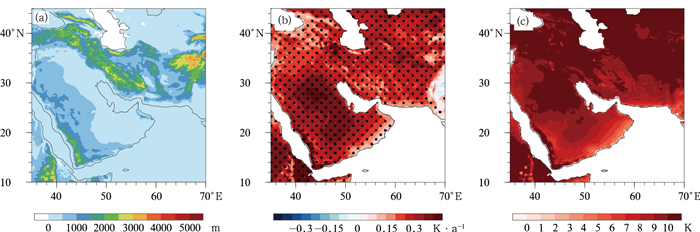
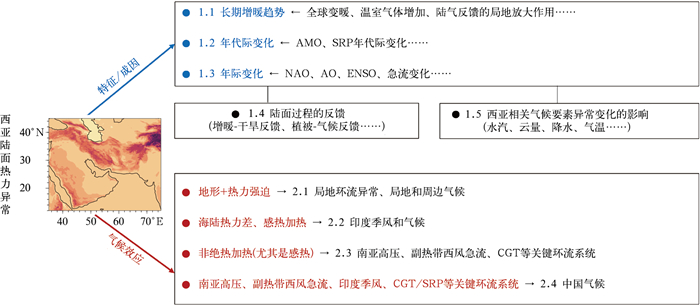
近年来,西亚地区作为陆面增暖的热点区域, 引起了科学界的广泛关注(Giorgi,2006;Hansen et al,2010;Cohen et al,2012;Zhou et al,2015;2016;Hong et al,2017)。西亚位于亚洲西南部,地形以高原、山地和沙漠为主,整体海拔较高、气候干燥;西亚陆面温度不仅呈现长期增暖趋势,还具有明显的年代际变化并伴有较强的年际变率(Hasanean and Almazroui, 2017;Ehsan et al,2020;图 1)。一方面,西亚陆面热力状况受大气环流变异、海温强迫、陆面反馈和人类活动等影响;另一方面,西亚陆面热力异常能通过热驱动环流影响周边气候,甚至通过大气遥相关影响下游气候。本文将回顾西亚陆面热力异常特征、成因及气候效应的研究进展(图 2),以期为未来研究提供参考。
|
图 1 1951—2021年西亚(a)地形,(b,c)陆面温度(ERA5)的(b)线性趋势和(c)标准差 注:打点区域通过0.05显著性水平检验。 Fig. 1 (a) Topography, and (b) linear trend and (c) standard deviation of land surface temperature in West Asia during 1951-2021 based on ERA5 data |
|
图 2 西亚陆面热力异常与成因及气候效应研究进展总结 Fig. 2 Summary of recent advance in the research on land surface thermal anomalies and their possible causes and climatic effects in West Asia |
目前关于西亚陆面热力异常特征及成因研究,主要针对不同时间尺度上西亚陆面热力异常及相关要素的变化特征和成因进行分析,并探讨陆面反馈对西亚陆面热力异常的作用。
1.1 西亚陆面热力异常长期趋势及成因的研究近几十年来西亚陆面增暖趋势显著,其中暖季较冷季增暖更强,最强的增暖季节为春季(Cohen et al,2012;Alizadeh and Babaei, 2022)。根据以往研究,干燥的气候背景是西亚增暖突出的重要原因。Huang et al(2012)发现,全球变暖背景下半干旱区的增暖趋势更强,这种现象可能是环流动力调整、海温异常、陆面过程和区域人类活动等多种因素共同作用的结果。Zhou et al(2015;2016)指出,全球中低纬度陆面温度随着植被增长减缓呈现急剧上升,尤其在阿拉伯半岛等沙漠地区的增暖率最强,西亚干旱地区存在明显的增暖放大效应。进一步分析表明,人类活动导致的温室气体排放有利于增强向下的长波辐射,使大气变得更潮湿和更暖,而干旱区气候对水汽变化极为敏感,因而出现更强的增暖,表明人类活动对西亚增暖的贡献不容忽视(Zhou et al,2015;2016)。
1.2 西亚陆面热力异常年代际变化特征及成因的研究伴随着显著的增暖趋势,西亚陆面年代际增暖现象也十分明显(Hong et al,2017;Sun et al,2019a; 2019b)。例如,1979—2009年阿拉伯半岛增暖速率为0.6℃·(10 a)-1,夏季阿拉伯半岛地表气温在20世纪80年代表现出显著的年代际增暖(Hasanean and Almazrroui, 2017;Ehsan et al,2020)。由于地理位置相近,不少学者发现夏季西亚和欧洲在20世纪90年代均出现年代际增暖,并将其作为一个整体来研究。Hong et al(2017)指出,西亚—欧洲增暖受到大西洋多年代际振荡(Atlantic multidecadal oscillation,AMO)及丝绸之路遥相关模态(Silk Road pattern,SRP)年代际变化的调控。考虑到AMO周期大约为65~80 a且已在20世纪90年代中期转变为正位相,西亚—欧洲的年代际增暖将会持续。进一步,Sun et al(2019a)采用大气数值模式进行集合试验,验证AMO正位相能激发类SRP,导致西亚—欧洲上空出现异常反气旋性环流,增强暖平流和向下短波辐射,引起地表增暖。此外,Ehsan et al(2020)通过分析观测和再分析数据,并利用耦合大气-海洋模式模拟发现,只要北大西洋持续异常增暖,西亚年代际增暖现象就将持续。Sun et al(2019b)应用气候反馈-响应分析方法对导致西亚—欧洲年代际增暖的辐射和非辐射过程的贡献进行了定量诊断。结果表明,辐射过程是导致增暖的主要原因,包括云量、CO2浓度和水汽含量的作用,其中最主要的驱动因素为云量;而地表感热、潜热和动力过程结合的非辐射过程贡献则相对较小。
1.3 西亚陆面热力异常年际变化特征及成因的研究年际尺度上,西亚陆面温度呈现出较大的变率(Yang et al,2021)。研究发现,在所有季节,西亚陆面温度深受热带海温变化的影响,且与厄尔尼诺-南方涛动(El Niño-Southern oscillation, ENSO)、北大西洋涛动(North Atlantic oscillation, NAO)和北极涛动(Arctic oscillation, AO)密切相关(Attada et al,2019a)。一些研究还指出,西亚陆面温度异常通常伴随着由中亚传来的波列引发的位势高度异常(Saeed et al,2011a;Watanabe and Yamazaki, 2014b),这种年际尺度上的遥相关可能也与ENSO有关(Watanabe and Yamazaki, 2014a)。此外,夏季西亚陆面温度变化与副热带西风急流的强度密切相关,副热带西风急流可以通过调控中纬度Rossby波列影响西亚地表温度(Attada et al,2018)。近期,Song et al(2022)探究了春季西亚—欧洲陆面温度年际变化主模态与大尺度大气遥相关模态的关系,发现西亚陆面热力异常与NAO的变化密切相关,当NAO为负位相时,伴随西亚上空的异常反气旋性环流,地表的辐射加热有利于增暖。
1.4 陆面反馈在西亚陆面热力异常中的作用近期,有研究从陆面过程对区域气候反馈的角度探讨了西亚陆面增暖的成因。例如,Barlow et al(2016)从植被反馈的角度出发,提出由于干旱加剧造成的植被减少可能对大气产生重要反馈,包括地表反照率变化导致的能量平衡反馈、蒸腾变化导致的水分收敛反馈、风蚀和扬尘效应等,并认为在变暖的气候中,西亚的植被反馈可能变得更加重要。Cook et al(2021)也发现了温室气体引起的西亚增暖放大现象,但将其主要归因于较干旱地区缺少潜热降温(蒸发冷却)的作用,强调了陆面水热状态对增暖的贡献,与Zittis et al(2014)的观点一致。这些研究表明,西亚的干旱特征有利于陆面异常增暖,而陆面温度的异常升高往往对应降水的异常减少(Tanarhte et al,2012),导致干旱进一步加剧(Barlow et al,2002;Sobhani et al,2020),形成增暖-干旱正反馈。
1.5 西亚陆面热力相关气候要素异常的成因研究西亚陆面热力异常与该区域相关要素变化之间也存在紧密联系(Song et al,2025),例如当地的水汽输送、降水和气温异常(Hasanean and Almazrroui, 2017;Almazroui et al,2012;Attada et al,2018;Kostopoulou et al,2014;Athar,2015;Ehsan et al,2019;Tuel et al,2022)。除了之前提到的NAO(Donat et al,2014;Al Senafi and Anis, 2015;Saeed et al,2023)、AMO(Sheffield and Wood, 2008;Ehsan et al,2020)、急流(Attada et al,2018;Niranjan et al,2016;Rana et al,2019)、ENSO(Chakraborty et al,2006;Abid et al,2018;Almazroui et al,2019;Hoell et al,2014;2015;2017;2018)的影响,也有研究指出了遥相关模态(Feldstein and Dayan, 2008;Almazroui et al,2019;Saeed et al,2023)、印度洋偶极子(Indian Ocean dipole,IOD)(Chakraborty et al,2006;Athar,2015;Al Senafi and Anis, 2015)、青藏高原(Lu et al,2018)、欧亚积雪(He et al,2024)、南亚季风(Tyrlis et al,2013;Babaeian and Rezazadeh, 2018;Attada et al,2019b)和太平洋年代际变化(Ma et al,2023)的显著作用。多项研究指出,不同热带和副热带海区的海温异常可以通过协同调控水汽输送与大气环流结构,对西亚陆面热力异常产生显著影响。Chakraborty et al(2006)和Hochman et al(2024)指出,当El Niño和IOD正位相事件同时发生时,输送到阿拉伯半岛的大气净水汽通量更多,进而造成降水偏多的异常响应。类似地,Syed et al(2006)发现,在NAO正位相和暖ENSO共同作用下,冰岛低压东伸、西伯利亚高压减弱,导致西亚上空形成异常低压槽,有利于该地区冬季降水的增多。此外,Hasanean and Almazroui(2017)指出,夏季热带北大西洋和热带南大西洋的海温变化会影响印度洋-太平洋暖池的海温,进而影响印度季风低压的强度,最终造成阿拉伯半岛地表气温异常。
2 西亚陆面热力异常的气候效应研究西亚陆面热力异常既受到大气环流变异的控制,又能对大气环流和气候产生重要的反馈作用。近年来,关于西亚陆面热力异常气候效应的研究逐渐增多,学者重点探讨了其对局地及周边地区气候、印度季风活动、关键环流系统、大气遥相关以及中国气候的影响。
2.1 西亚陆面热力异常对局地和周边气候的影响西亚包括伊朗高原、扎格罗斯山脉、阿拉伯高原和亚美尼亚高原等高海拔地区。高耸的地形能对大气产生机械强迫(Simpson et al,2015)及隔热作用(Boos and Kuang, 2010)。研究发现,扎格罗斯山脉的阻挡和抬升作用有利于增强降水,导致扎格罗斯的南坡、东南坡和陡坡出现强降水(Kiani et al,2019)。此外,由于地形抬升引起的加热作用,特定等压面在高原上往往比周围非抬升地形的温度更高(Hu and Boos, 2017a;2017b),抬升的陆面热力异常也能对较高层大气产生直接的非绝热加热,进而对局地环流和周围气候产生影响。Zaitchik et al(2007)指出,扎格罗斯山脉夏季地表异常加热会激发近地层热低压和上升运动,抽吸伊朗高原西侧爬坡气流,加强中东平原的地中海季风,形成闭合的平原-高原环流,导致中东平原的异常下沉气流、绝热增暖和降水减少。Gevorgya and Melkonyan(2015)发现,由于强的陆气温差,亚美尼亚高原上空的大气比周围离地面较远的大气更容易受到地表加热的影响;同时,巨大的山脉阻挡了来自里海和黑海的偏东、偏北冷空气,促使高原内部绝热变暖和陆面加热。近年来, 陆面增暖有利于亚美尼亚高原上空热驱动环流进一步增强。而在人类活动导致的陆面过程对大气的热力强迫方面,Marcella and Eltahir(2012)指出,对西亚地区人类灌溉和沙尘排放的准确表述对合理模拟当地气候十分重要。
2.2 西亚陆面热力异常对印度季风及印度次大陆气候的影响西亚地区邻近印度季风区,西亚陆面热力异常能通过调节海陆热力差异影响印度季风及印度次大陆气候。观测分析和数值模拟均表明,伊朗高原热力异常是驱动印度季风的关键强迫(He et al,2019;Zhang et al,2019;Hu et al,2022),其中感热加热为伊朗高原的重要加热形式,春季、夏季为主导加热。夏季伊朗高原地表感热加热能激发近地面气旋性环流,有利于增强来自阿拉伯海的西南水汽输送,导致巴基斯坦、印度北部及青藏高原西南坡降水增多,而阿拉伯半岛降水减少(Wu et al,2012;刘屹岷等,2017)。值得注意的是,季风降水伴随的潜热释放也能进一步加热大气,表明潜热加热在伊朗高原对印度季风的热力调节过程中起到了重要的反馈。还有研究指出,夏季扎格罗斯山脉隆起的隔热作用也有利于印度季风的发展,扎格罗斯山脉的存在有利于青藏高原南部的对流层高层温度升高,进而驱动印度季风(Tang et al,2013)。此外,季风爆发前阿拉伯半岛陆面感热加热对印度季风爆发的作用也不容忽视(Zhang et al, 2013; 张亚妮等,2013)。根据热力适应定理(刘屹岷等,1999;吴国雄和刘屹岷,2000),阿拉伯半岛感热加热强迫对流层低层出现气旋性环流而中层出现反气旋性环流,促使阿拉伯海上空的副热带高压西撤至阿拉伯半岛上空,位涡纬向非对称不稳定逐渐发展,有助于形成印度季风爆发涡旋。
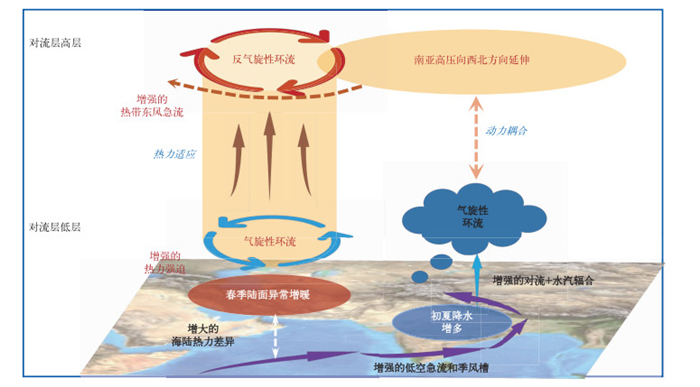
最近,越来越多研究关注前期春季西亚陆面热力异常对印度季风降水的影响。观测表明,春季西亚地区正以0.5℃·(10 a)-1的速度升温,西亚增暖能促使低空急流不断北移,造成巴基斯坦等印度季风边缘区的夏季降水增多,洪涝风险随之增加(Li et al,2023)。此外,西亚增暖也有利于增强季风槽及印度北部的水汽辐合和上升运动,并能激发对流层高层反气旋性异常环流,促使热带东风急流增强和南亚高压西伸北进;初夏,印度北部上空增强的南亚高压与中低层气旋性异常环流动力耦合,降水随之偏多(Yang and Chen, 2022; 图 3)。
|
图 3 西亚春季陆面热力异常影响印度初夏季风降水物理机制示意图(Yang and Chen, 2022) Fig. 3 Schematic diagram on physical mechanisms of anomalous spring land surface warming in West Asia affecting Indian monsoon precipitation in early summer (cited from Yang and Chen, 2022) |
伊朗高原上空的副热带高压是西亚对流层中高层夏季环流的主要特征之一,简称伊朗高压(Zarrin et al,2010)。研究指出,扎格罗斯山脉对伊朗高压的形成和维持起重要作用,若将其去除,非绝热加热的大小和空间分布会显著变化,垂直平流和对流层中层的反气旋均明显减弱,伊朗高压消失于伊朗西部(Zarrin et al,2011)。同样受大地形的动力和热力作用,夏季南亚高压根据中心位置的不同,分为青藏高压型和伊朗高压型两个平衡态,西亚陆面热力异常对南亚高压的形态和强度也有着显著影响(Zhang et al,2002;Shi and Qian, 2016)。伴随南亚高压趋向于伊朗高原,印度夏季风降水也随之增多(Wei et al,2014;2015)。对于前期陆面热力信号的作用,Zhang et al(2019)发现,初夏南亚高压的位置受到春末伊朗高原地表感热异常的强烈影响,当春末伊朗高原感热偏强时,春末—初夏印度北部对流层低层出现异常气旋,伴随大气上升运动和水汽辐合,导致印度北部潜热释放增强,对流层高层视热源垂直梯度减小,初夏南亚高压向西北方向移动。
西亚对流层高空存在副热带西风急流。西亚急流的南北位置与急流波导(Hoskins and Ambrizzi, 1993)的Rossby波活动均能影响下游大气环流和气候。研究发现,夏季地中海和北大西洋—斯堪的纳维亚半岛对流层高层的负涡度源区和E-P通量强辐散区为Rossby波源区,波源区的位置和强度变化会引起其激发的沿西亚急流东传的Rossby波活动异常。当西亚急流位置偏南时,其中的Rossby波活动偏弱(杨莲梅和张庆云,2008)。而偏南的西亚急流,有利于沿青藏高原南麓穿过印度次大陆的异常西南暖湿气流从低纬度进入中亚和新疆北部,促使当地降水增多(Zhao et al,2014)。此外,西亚上空的异常波动也能被急流捕获进而传播到下游。近期研究表明,西亚北部的陆面热力异常能在西亚西北部强迫出异常高压和沿急流东传的波列,且这种高层环流响应具有明显的位相锁定;而伊朗高原地形导致的局地基本气流的纬向变化是维持西亚北部位相锁定的一个重要原因(Wang et al,2019)。
大气环流遥相关是空间上相距较远的区域环流之间存在显著时间相关性的现象,其形成与外强迫激发的Rossby波密切相关(Hoskins and Karoly, 1981;Simmons et al,1983;Li and Ji, 1997)。Ding and Wang(2005)提出的北半球夏季环球遥相关(circumglobal teleconnection,CGT)作为一种典型的大气环流遥相关模态,是以西亚(35°~40°N、60°~ 70°E)为参考区域计算所得北半球夏季200 hPa位势高度的单点相关。CGT呈现环球定常纬向5波分布,包括位于西亚、东亚、北太平洋、北美、西欧和欧洲俄罗斯上空的6个显著波活动中心。研究指出,CGT呈现多尺度分布,沿北非—亚洲急流分布的SRP(Lu et al,2002;Enomoto et al,2003;Enomoto,2004)可以被看作CGT的区域性表现(Krishnan and Sugi, 2001;Yasui and Watanabe, 2010;Zhou et al,2019)。根据定义,CGT与西亚地区的大气低频环流密切相关。已有研究证明,这个波包起源于西亚,进而沿西风急流向东传播(Enomoto et al,2003;Enomoto,2004;Sato and Takahashi, 2006;Chen and Huang, 2012),即西亚的非绝热加热有助于CGT形成(Enomoto et al,2003;Saeed et al,2011b)。例如,Saeed et al(2011b)发现,西亚上空降水/对流增强引起的低层热低压增强,可激发出类CGT模态,延伸至亚洲季风区。此外,不少研究还指出,印度夏季风加热有利于在其西北部形成Gill型Rossby波(Gill,1980),认为CGT可能是中纬度西风带对印度季风热源响应的结果(Ding and Wang, 2005;Chen and Huang, 2012;Lin,2009;Wang et al,2012;Lee and Ha, 2015;Dutta and Neena, 2022)。从陆面热力直接强迫出发,有分析发现春季西亚陆面热力异常可能通过影响初夏CGT进而影响中国东北冷涡活动,西亚陆面异常增暖往往对应东北冷涡活动偏弱,表明西亚的陆面热力状况作为下垫面条件对CGT的形成和维持具有潜在贡献(王迪等,2018)。最新研究证实,西亚陆面热力反馈是导致20世纪90年代以来初夏CGT显著增强的重要驱动力(Banerjee et al,2025)。针对西亚和印度地区的非绝热加热对CGT的相对贡献问题,Yasui and Watanabe(2010)应用简单线性大气模式进行数值试验发现,对稳定CGT响应贡献最大的同期非绝热加热关键区位于西亚,并认为西亚的非绝热加热可能与CGT相耦合,而印度地区非绝热加热的作用相对较弱。
2.4 西亚陆面热力异常对中国气候的影响研究西亚陆面热力异常导致的南亚高压位置及强度变化不仅影响印度夏季风,也会影响东亚夏季风(Sun et al,2010),进而对中国降水和气温产生影响(张琼和吴国雄,2001;钱永甫等,2002;胡景高等,2010;Wei et al,2014;2015;Ren et al,2015)。一方面,伴随南亚高压的增强和东伸,西太平洋副热带高压加强并西进,进而影响中国降水(Jiang et al,2011;Guan et al,2018;Wei et al,2019a);另一方面,受西亚陆面热力调控的印度夏季风进程和强弱的变化能够影响向东亚传输的水汽,引起降水异常变化(Zhang,2001;Liu and Huang, 2019)。同时,印度季风潜热加热也能通过调节南亚高压的活动进一步影响中国降水(Wei et al,2014;2019b)。此外,对于中国西北部的非季风区,伊朗高原的感热加热、南亚高压的强度及位置变化也可以通过调节大尺度环流和水汽输送影响中国西北部的降水和气温(杨莲梅,2003;王前等,2017;赵勇等, 2018, 陈佳毅和赵勇,2023)。
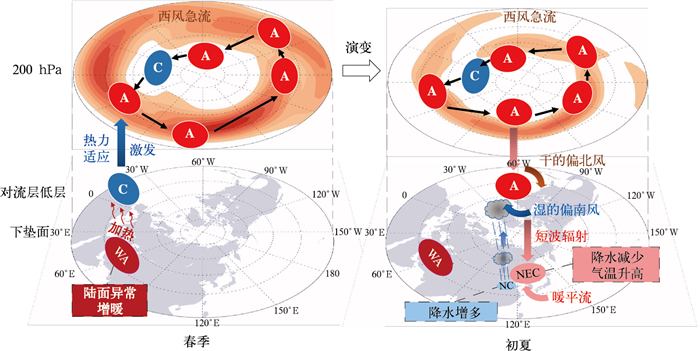
此外,CGT/SRP通过将印度季风和东亚夏季风连接起来(Ding and Wang, 2005;Lu et al,2002;Enomoto et al,2003;Lee et al,2011;Wu et al,2016;Liu and Huang, 2019;Dutta and Neena, 2022),进而影响中国气候(Hsu and Lin, 2007;Huang et al,2011;Kosaka et al,2011;Wang and He, 2015;林大伟等,2016;Bueh et al,2016;Zhang et al,2019b;Na and Lu, 2023)。同时,与西亚陆面热力异常密切相关的南亚高压变化也能引起与CGT具有较高时空相似性的遥相关模态,进而影响东亚夏季风降水;东亚夏季风降水产生的非绝热加热反馈对CGT的维持也有重要作用(Zhou et al,2020),说明西亚热力异常引起的季风降水潜热反馈不容忽视。着眼于西亚热力异常对CGT的直接强迫作用,研究发现,西亚春季陆面热力异常不仅能导致初夏CGT异常和中国北方环流异常,还能对当地降水和气温产生影响。西亚异常增暖通过加热上空大气引起斜压不稳定,触发沿西风急流向东传播的Rossby波,形成环北半球的低频波列。从春季到初夏,由于陆面热力强迫的作用和基本气流与异常波列的相互作用,异常波列逐渐增强和演变,在初夏呈现类似CGT的分布,增强的CGT位于东亚波活动中心影响中国北方的环流及气候(陈海山等,2018;Yang et al,2021; 图 4)。从年代际变化的角度深入分析发现,1990年之后西亚春季陆面热力异常与初夏CGT及东北降水的关系明显加强,这种变化可能与西风急流的年代际转变有关(Sun et al,2024)。最新研究还发现,2022年盛夏长江流域破纪录的高温热浪也与前期西亚非绝热加热密不可分,巴基斯坦地区降水偏多引起的异常加热可以通过增强CGT引起南亚高压东伸,有利于长江流域高温的持续(Tang et al,2023;Fu et al,2024)。上述研究表明,近年来西亚陆面热力异常对我国气候的影响日益显著,加强对这一地区的监测与研究将有助于提高我国气候的预测水平。
|
图 4 西亚春季陆面热力异常影响我国北方初夏气候物理机制示意图(Yang et al,2021) 注:WA、NC、NEC分别代表西亚、中国华北和中国东北地区;粗箭头代表风向;200 hPa上A/C代表反气旋/气旋异常环流,细箭头代表Rossby波传播方向,填色深/浅为强/弱西风急流。 Fig. 4 Schematic diagram on physical mechanisms of spring land surface warming in West Asia affecting early summer climate over northern China (cited from Yang et al, 2021) |
本文回顾了全球变暖背景下西亚地区陆面热力异常的特征、成因及气候效应的研究进展。从地理位置来看,西亚地区是连接亚-欧-非三大洲的枢纽地带,关注西亚热力异常现象和前兆信号以及对大气的反馈影响,有助于进一步理解和应对气候变化。从气候背景来看,西亚属于半干旱-干旱气候区,在增暖的大前提下,较干旱的区域更缺乏潜热降温的作用,并对由增暖导致的水汽变化较敏感,因而存在增暖放大效应。同时,由于西亚的平均海拔较高,包括伊朗高原、扎格罗斯山脉等高海拔地区,高地形的隔热效应有利于内部绝热增温,而抬升的陆面增暖又能够直接加热较高层大气,进而影响周围环流,甚至通过遥相关影响下游气候。因此,探究西亚陆面热力异常的成因和气候效应具有重要的现实意义和科学价值。
然而,由于观测资料的缺乏,此前研究通常选用再分析的土壤温度、地表温度、感热通量或距地2 m气温等变量来表征西亚陆面热力状况,但这些变量具有不同的物理意义,不同再分析资料之间也存在系统性差异。未来研究可以加强基于多源数据对不同时段的西亚热力异常特征进行多角度对比分析,并明确其物理内涵,将有利于更全面认识西亚陆面热力异常的基本特征。从现有的研究来看,该区域的热力异常主要通过非绝热加热来影响大气环流进而对气候产生影响。对于干旱区而言,非绝热加热的重要分量是地表感热加热,加强相关地表通量观测并结合多源资料分析将有助于深入理解其气候效应。此外,西亚陆面热力异常存在明显的季节差异,虽然相较于冷季,西亚地区暖季的增暖趋势更为显著,目前的研究也大多关注暖季的增暖现象,但西亚冷季热力异常的现象和特征也值得深入探究。
此外,尽管已有不少研究关注了西亚热力异常的成因和气候效应,但仍需从海-陆-气耦合的角度深入理解西亚热力异常在气候系统中的作用。一方面,目前对于西亚热力异常的多尺度变异机理缺乏深刻理解,以往研究主要强调了人类活动和AMO大尺度信号对西亚陆面增暖趋势的影响,对其年际和年代际变化的关注还不够,相关机制尚不明晰。但是,深入理解其年际和年代际变化机理,对于短期气候预测至关重要。比如,海温、海冰外强迫通过动力、热力过程影响西亚陆面热力异常的物理机制是什么?局地陆气相互作用在西亚陆面热力异常年际、年代际变化中起什么作用?还有待进一步探究。另一方面,目前对于西亚热力异常的气候效应仍缺乏系统性认识。此前研究强调了印度季风及降水的显著响应,但主要从季节预测的角度进行分析,对于受西亚前期陆面热力异常影响的季风爆发及其发展具体过程仍未得到充分研究。
还值得注意的是,由于印度季风与南海季风、东亚季风存在密切的关联,西亚陆面热力异常是否与南海和东亚季风存在关联也有待深入研究。西亚地区靠近第三极,全球变暖背景下大地形的热力异常协同影响季风环流的机制也值得进一步探究。在西亚热力异常激发热驱动环流和低频波列,进而影响中国北方环流和气候的过程中,强迫波与基本气流之间的相互作用对CGT的影响仍需深入研究。此外,作为西亚热力异常-中国北方气候遥相关中的关键过程,印度季风降水加热在遥相关中起到怎样的作用,值得深入研究,以进一步加深对中国北方气候变异的理解,助力提升降水和气温的预测水平。
陈海山, 杨静秋, 张莞昕, 等, 2018. 中国东北初夏降水与冷涡活动及西亚春季陆面热力异常的可能联系[J]. 海洋气象学报, 38(1): 10-16. Chen H S, Yang J Q, Zhang W X, et al, 2018. Possible linkages among early summer precipitation in Northeast China, cold vortex and spring land surface thermal anomaly over West Asia[J]. J Marine Meteor, 38(1): 10-16 (in Chinese).
|
陈佳毅, 赵勇, 2023. 伊朗高原和青藏高原夏季加热对塔里木盆地降水的影响[J]. 高原气象, 42(4): 858-869. Chen J Y, Zhao Y, 2023. Effects of the summer heating over the Iranian Plateau and the Qinghai-Xizang Plateau on precipitation over the Tarim Basin[J]. Plateau Meteor, 42(4): 858-869 (in Chinese).
|
胡景高, 周兵, 陶丽, 2010. 南亚高压特征参数与我国夏季降水的关系分析[J]. 气象, 36(4): 51-56. Hu J G, Zhou B, Tao L, 2010. Comparative analysis of the relation between characteristic parameters of South Asia high and summer precipitation of China[J]. Meteor Mon, 36(4): 51-56 (in Chinese). DOI:10.7519/j.issn.1000-0526.2010.4.009
|
黄荣辉, 周德刚, 陈文, 等, 2013. 关于中国西北干旱区陆-气相互作用及其对气候影响研究的最近进展[J]. 大气科学, 37(2): 189-210. Huang R H, Zhou D G, Chen W, et al, 2013. Recent progress in studies of air-land interaction over the arid area of Northwest China and its impact on climate[J]. Chin J Atmos Sci, 37(2): 189-210 (in Chinese).
|
李建平, 任荣彩, 齐义泉, 等, 2013. 亚洲区域海-陆-气相互作用对全球和亚洲气候变化的作用研究进展[J]. 大气科学, 37(2): 518-538. Li J P, Ren R C, Qi Y Q, et al, 2013. Progress in air-land-sea interactions in Asia and their role in global and Asian climate change[J]. Chin J Atmos Sci, 37(2): 518-538 (in Chinese).
|
林大伟, 布和朝鲁, 谢作威, 2016. 夏季中国华北与印度降水之间的关联及其成因分析[J]. 大气科学, 40(1): 201-214. Lin D W, Bueh C L, Xie Z W, 2016. Relationship between summer rainfall over North China and India and its genesis analysis[J]. Chin J Atmos Sci, 40(1): 201-214 (in Chinese).
|
刘屹岷, 刘辉, 刘平, 等, 1999. 空间非均匀加热对副热带高压形成和变异的影响II: 陆面感热与东太平洋副高[J]. 气象学报, 57(4): 385-396. Liu Y M, Liu H, Liu P, et al, 1999. The effect of spatially nonuniform heating on the formation and variation of subtropical high Part Ⅱ: land surface sensible heating and East Pacific subtropical high[J]. Acta Meteor Sin, 57(4): 385-396 (in Chinese).
|
刘屹岷, 王子谦, 卓海峰, 等, 2017. 夏季亚洲大地形双加热及近对流层顶位涡强迫的激发Ⅱ: 伊朗高原-青藏高原感热加热[J]. 中国科学: 地球科学, 47(3): 354-366. Liu Y M, Wang Z Q, Zhuo H F, et al, 2017. Two types of summertime heating over Asian large-scale orography and excitation of potential-vorticity forcing Ⅱ. sensible heating over Tibetan-Iranian Plateau[J]. Sci China: Earth Sci, 47(3): 354-366 (in Chinese).
|
钱永甫, 张琼, 张学洪, 2002. 南亚高压与我国盛夏气候异常[J]. 南京大学学报(自然科学版), 38(3): 295-307. Qian Y F, Zhang Q, Zhang X H, 2002. The South Asian high and its effects on China's mid-summer climate abnormality[J]. J Nanjing Univ (Nat Sci), 38(3): 295-307 (in Chinese).
|
王迪, 陈海山, 赵昶昱, 2018. 春季西亚地表热力异常与初夏东北冷涡活动年代际变化的联系[J]. 大气科学, 42(1): 70-80. Wang D, Chen H S, Zhao C Y, 2018. Connection between spring land surface thermal anomalies over West Asia and decadal variation of early summer cold vortex in Northeast China[J]. Chin J Atmos Sci, 42(1): 70-80 (in Chinese).
|
王前, 赵勇, 陈飞, 等, 2017. 南亚高压的多模态特征及其与新疆夏季降水的联系[J]. 高原气象, 36(5): 1209-1220. Wang Q, Zhao Y, Chen F, et al, 2017. Characteristics of different patterns of South Asia high and their relationships with summer precipitation in Xinjiang[J]. Plateau Meteor, 36(5): 1209-1220 (in Chinese).
|
吴国雄, 刘屹岷, 2000. 热力适应、过流、频散和副高Ⅰ.热力适应和过流[J]. 大气科学, 24(4): 433-446. Wu G X, Liu Y M, 2000. Thermal adaptation, overshooting, dispersion, and subtropical anticyclone Part Ⅰ: thermal adaptation and overshooting[J]. Chin J Atmos Sci, 24(4): 433-446 (in Chinese).
|
肖子牛, 潘宝祥, 2025. 极端天气事件和天气气候一体化预报技术的现状及展望[J]. 气象, 51(11): 1383-1394. Xiao Z N, Pan B X, 2025. Extreme weather events and integrated forecasting techniques for weather and climate: current status and prospect[J]. Meteor Mon, 51(11): 1383-1394 (in Chinese). DOI:10.7519/j.issn.1000-0526.2025.070801
|
杨莲梅, 2003. 南亚高压突变引起的一次新疆暴雨天气研究[J]. 气象, 29(8): 21-25. Yang L M, 2003. Research on a case of heavy rain in Xinjiang from South Asia high abnormity[J]. Meteor Mon, 29(8): 21-25 (in Chinese). DOI:10.7519/j.issn.1000-0526.2003.8.005
|
杨莲梅, 张庆云, 2008. 夏季沿西亚急流Rossby波活动异常的波源和能量传播及转换特征[J]. 气象学报, 66(4): 555-565. Yang L M, Zhang Q Y, 2008. Wave sources, energy propagation and conversion for anomalous Rossby wave activities along West Asian jet stream[J]. Acta Meteor Sin, 66(4): 555-565 (in Chinese).
|
张强, 王蓉, 岳平, 等, 2017. 复杂条件陆-气相互作用研究领域有关科学问题探讨[J]. 气象学报, 75(1): 39-56. Zhang Q, Wang R, Yue P, et al, 2017. Several scientific issues about the land-atmosphere interaction under complicated conditions[J]. Acta Meteor Sin, 75(1): 39-56 (in Chinese).
|
张琼, 吴国雄, 2001. 长江流域大范围旱涝与南亚高压的关系[J]. 气象学报, 59(5): 569-577. Zhang Q, Wu G X, 2001. The large area flood and drought over Yangtze River valley and its relation to the South Asia high[J]. Acta Meteor Sin, 59(5): 569-577 (in Chinese).
|
张亚妮, 吴国雄, 刘屹岷, 等, 2013. 南亚高压的不稳定和位涡纬向非对称强迫对印度夏季风爆发的影响[J]. 中国科学: 地球科学, 43(12): 2072-2085. Zhang Y N, Wu G X, Liu Y M, et al, 2013. The effects of asymmetric potential vorticity forcing on the instability of South Asia high and Indian summer monsoon onset[J]. Sci China Earth Sci, 43(12): 2072-2085 (in Chinese).
|
赵勇, 王前, 黄安宁, 2018. 南亚高压伊朗高压型与新疆夏季降水的联系[J]. 高原气象, 37(3): 651-661. Zhao Y, Wang Q, Huang A N, 2018. Relationship between Iran high pattern of South Asia high and summer precipitation in Xinjiang[J]. Plateau Meteor, 37(3): 651-661 (in Chinese).
|
Abid M A, Almazroui M, Kucharski F, et al, 2018. ENSO relationship to summer rainfall variability and its potential predictability over Arabian Peninsula Region[J]. npj Climate Atmos Sci, 1(1): 20171. DOI:10.1038/s41612-017-0003-7
|
Al Senafi F, Anis A, 2015. Shamals and climate variability in the Northern Arabian/Persian Gulf from 1973 to 2012[J]. Int J Climatol, 35(15): 4509-4528. DOI:10.1002/joc.4302
|
Alizadeh O, Babaei M, 2022. Seasonally dependent precipitation changes and their driving mechanisms in Southwest Asia[J]. Climatic Change, 171(3): 20.
|
Almazroui M, Islam M N, Jones P D, et al, 2012. Recent climate change in the Arabian Peninsula: seasonal rainfall and temperature climatology of Saudi Arabia for 1979-2009[J]. Atmos Res, 111: 29-45. DOI:10.1016/j.atmosres.2012.02.013
|
Almazroui M, Rashid I U, Saeed S, et al, 2019. ENSO influence on summer temperature over Arabian Peninsula: role of mid-latitude circulation[J]. Climate Dyn, 53(7): 5047-5062.
|
Amenu G G, Kumar P, Liang X Z, 2005. Interannual variability of deep-layer hydrologic memory and mechanisms of its influence on surface energy fluxes[J]. J Climate, 18(23): 5024-5045. DOI:10.1175/JCLI3590.1
|
Athar H, 2015. Teleconnections and variability in observed rainfall over Saudi Arabia during 1978-2010[J]. Atmos Sci Lett, 16(3): 373-379. DOI:10.1002/asl2.570
|
Attada R, Dasari H P, Chowdary J S, et al, 2019a. Surface air temperature variability over the Arabian Peninsula and its links to circulation patterns[J]. Int J Climatol, 39(1): 445-464. DOI:10.1002/joc.5821
|
Attada R, Dasari H P, Parekh A, et al, 2019b. The role of the Indian summer monsoon variability on Arabian Peninsula summer climate[J]. Climate Dyn, 52(5): 3389-3404.
|
Attada R, Yadav R K, Kunchala R K, et al, 2018. Prominent mode of summer surface air temperature variability and associated circulation anomalies over the Arabian Peninsula[J]. Atmos Sci Lett, 19(11): e860. DOI:10.1002/asl.860
|
Babaeian I, Rezazadeh P, 2018. On the relationship between Indian monsoon withdrawal and Iran's fall precipitation onset[J]. Theoret Appl Climatol, 134(1): 95-105.
|
Banerjee A, Gupta S, Priyanshu P, et al, 2025. Recent changes in spatiotemporal patterns of heat extremes in South Asia[J]. npj Clim Atmos Sci, 8(1): 293. DOI:10.1038/s41612-025-01146-1
|
Barlow M, Cullen H, Lyon B, 2002. Drought in central and southwest Asia: La Ni a, the warm pool, and Indian Ocean precipitation[J]. J Climate, 15(7): 697-700. DOI:10.1175/1520-0442(2002)015<0697:DICASA>2.0.CO;2
|
Barlow M, Zaitchik B, Paz S, et al, 2016. A review of drought in the Middle East and Southwest Asia[J]. J Climate, 29(23): 8547-8574. DOI:10.1175/JCLI-D-13-00692.1
|
Betts A K, 2009. Land-surface-atmosphere coupling in observations and models[J]. J Adv Model Earth Syst, 1(3): 4.
|
Boer G J, 2011. The ratio of land to ocean temperature change under global warming[J]. Climate Dyn, 37(11): 2253-2270.
|
Boos W R, Kuang Z M, 2010. Dominant control of the South Asian monsoon by orographic insulation versus plateau heating[J]. Nature, 463(7278): 218-222. DOI:10.1038/nature08707
|
Bueh C, Li Y, Lin D W, et al, 2016. Interannual variability of summer rainfall over the northern part of China and the related circulation features[J]. J Meteor Res, 30(5): 615-630. DOI:10.1007/s13351-016-5111-5
|
Chakraborty A, Behera S K, Mujumdar M, et al, 2006. Diagnosis of tropospheric moisture over Saudi Arabia and influences of IOD and ENSO[J]. Mon Wea Rev, 134(2): 598-617. DOI:10.1175/MWR3085.1
|
Chen G S, Huang R H, 2012. Excitation mechanisms of the teleconnection patterns affecting the July precipitation in Northwest China[J]. J Climate, 25(22): 7834-7851. DOI:10.1175/JCLI-D-11-00684.1
|
Chen H S, 2022. Key regions where land surface processes shape the East Asian climate[J]. Atmos Ocean Sci Lett, 15(3): 100209. DOI:10.1016/j.aosl.2022.100209
|
Cohen J, Rind D, 1991. The effect of snow cover on the climate[J]. J Climate, 4(7): 689-706. DOI:10.1175/1520-0442(1991)004<0689:TEOSCO>2.0.CO;2
|
Cohen J L, Furtado J C, Barlow M, et al, 2012. Asymmetric seasonal temperature trends[J]. Geophys Res Lett, 39(4): L04705.
|
Cook K H, Vizy E K, Liu Y, et al, 2021. Greenhouse-gas induced warming amplification over the Arabian Peninsula with implications for Ethiopian rainfall[J]. Climate Dyn, 57(11): 3113-3133.
|
Ding Q H, Wang B, 2005. Circumglobal teleconnection in the Northern Hemisphere summer[J]. J Climate, 18(17): 3483-3505. DOI:10.1175/JCLI3473.1
|
Donat M G, Peterson T C, Brunet M, et al, 2014. Changes in extreme temperature and precipitation in the Arab Region: long-term trends and variability related to ENSO and NAO[J]. Int J Climatol, 34(3): 581-592. DOI:10.1002/joc.3707
|
Dong B W, Gregory J M, Sutton R T, 2009. Understanding land-sea warming contrast in response to increasing greenhouse gases. Part Ⅰ: transient adjustment[J]. J Climate, 22(11): 3079-3097. DOI:10.1175/2009JCLI2652.1
|
Dutta A, Neena J M, 2022. Exploring the circum-global teleconnection-Indian summer monsoon interactions in the interannual and multidecadal timescales[J]. Front Earth Sci, 10: 973468. DOI:10.3389/feart.2022.973468
|
Ehsan M A, Kucharski F, Almazroui M, et al, 2019. Potential predictability of Arabian Peninsula summer surface air temperature in the North American multimodel ensemble[J]. Climate Dyn, 53(7): 4249-4266.
|
Ehsan M A, Nicolì D, Kucharski F, et al, 2020. Atlantic Ocean influence on Middle East summer surface air temperature[J]. npj Climate Atmos Sci, 3(1): 5. DOI:10.1038/s41612-020-0109-1
|
Enomoto T, 2004. Interannual variability of the Bonin High associated with the propagation of Rossby waves along the Asian jet[J]. J Meteor Soc Japan Ser.II, 82(4): 1019-1034. DOI:10.2151/jmsj.2004.1019
|
Enomoto T, Hoskins B J, Matsuda Y, 2003. The formation mechanism of the Bonin high in August[J]. Quart J Roy Meteor Soc, 129(587): 157-178. DOI:10.1256/qj.01.211
|
Feldstein S B, Dayan U, 2008. Circumglobal teleconnections and wave packets associated with Israeli winter precipitation[J]. Quart J Roy Meteor Soc, 134(631): 455-467. DOI:10.1002/qj.225
|
Fischer E M, Seneviratne S I, Lüthi D, et al, 2007. Contribution of land-atmosphere coupling to recent European summer heat waves[J]. Geophys Res Lett, 34(6): L06707.
|
Fu Z H, Zhou W, Xie S P, et al, 2024. Dynamic pathway linking Pakistan flooding to East Asian heatwaves[J]. Sci Adv, 10(17): eadk9250. DOI:10.1126/sciadv.adk9250
|
Gao Z, Horton R, Liu H P, 2010. Impact of wave phase difference between soil surface heat flux and soil surface temperature on soil surface energy balance closure[J]. J Geophys Res: Atmos, 115(D16): D16112.
|
Gevorgyan A, Melkonyan H, 2015. Regional impact of the Armenian Highland as an elevated heat source: ERA-Interim reanalysis and observations[J]. Climate Dyn, 44(5): 1541-1565.
|
Gill A E, 1980. Some simple solutions for heat-induced tropical circulation[J]. Quart J Roy Meteor Soc, 106(449): 447-462.
|
Giorgi F, 2006. Climate change hot-spots[J]. Geophys Res Lett, 33(8): L08707.
|
Guan W N, Ren X J, Shang W, et al, 2018. Subseasonal zonal oscillation of the western Pacific subtropical high during early summer[J]. J Meteor Res, 32(5): 768-780. DOI:10.1007/s13351-018-8061-2
|
Hansen J, Ruedy R, Sato M, et al, 2010. Global surface temperature change[J]. Rev Geophys, 48(4): RG4004.
|
Hasanean H M, Almazroui M, 2017. Teleconnections of the tropical sea surface temperatures to the surface air temperature over Saudi Arabia in summer season[J]. Int J Climatol, 37(2): 1040-1049. DOI:10.1002/joc.4758
|
He B, Liu Y M, Wu G X, et al, 2019. The role of air-sea interactions in regulating the thermal effect of the Tibetan-Iranian Plateau on the Asian summer monsoon[J]. Climate Dyn, 52(7): 4227-4245.
|
He J R, Zhu S G, Chen H S, et al, 2024. Impacts of winter eurasian snow cover anomalies on the surface air temperature variability over West Asia[J]. J Meteor Res, 38(4): 733-748. DOI:10.1007/s13351-024-3206-y
|
Hochman A, Shachar N, Gildor H, 2024. Unraveling sub-seasonal precipitation variability in the Middle East via Indian Ocean sea surface temperature[J]. Sci Rep, 14(1): 2919. DOI:10.1038/s41598-024-53677-x
|
Hoell A, Barlow M, Cannon F, et al, 2017. Oceanic origins of historical Southwest Asia precipitation during the boreal cold season[J]. J Climate, 30(8): 2885-2903. DOI:10.1175/JCLI-D-16-0519.1
|
Hoell A, Barlow M, Xu T Y, et al, 2018. Cold season Southwest Asia precipitation sensitivity to El Niño-Southern Oscillation events[J]. J Climate, 31(11): 4463-4482. DOI:10.1175/JCLI-D-17-0456.1
|
Hoell A, Funk C, Barlow M, 2014. La Ni a diversity and northwest Indian Ocean rim teleconnections[J]. Climate Dyn, 43(9): 2707-2724.
|
Hoell A, Shukla S, Barlow M, et al, 2015. The forcing of monthly precipitation variability over Southwest Asia during the boreal cold season[J]. J Climate, 28(18): 7038-7056. DOI:10.1175/JCLI-D-14-00757.1
|
Hong X W, Lu R Y, Li S L, 2017. Amplified summer warming in Europe-West Asia and Northeast Asia after the mid-1990s[J]. Environ Res Lett, 12(9): 094007. DOI:10.1088/1748-9326/aa7909
|
Hoskins B J, Ambrizzi T, 1993. Rossby wave propagation on a realistic longitudinally varying flow[J]. J Atmos Sci, 50(12): 1661-1671. DOI:10.1175/1520-0469(1993)050<1661:RWPOAR>2.0.CO;2
|
Hoskins B J, Karoly D J, 1981. The steady linear response of a spherical atmosphere to thermal and orographic forcing[J]. J Atmos Sci, 38(6): 1179-1196. DOI:10.1175/1520-0469(1981)038<1179:TSLROA>2.0.CO;2
|
Hsu H H, Lin S M, 2007. Asymmetry of the tripole rainfall pattern during the East Asian summer[J]. J Climate, 20(17): 4443-4458. DOI:10.1175/JCLI4246.1
|
Hu S N, Boos W R, 2017a. Competing effects of surface albedo and orographic elevated heating on regional climate[J]. Geophys Res Lett, 44(13): 6966-6973. DOI:10.1002/2016GL072441
|
Hu S N, Boos W R, 2017b. The physics of orographic elevated heating in radiative-convective equilibrium[J]. J Atmos Sci, 74(9): 2949-2965. DOI:10.1175/JAS-D-16-0312.1
|
Hu W T, Duan A M, He B, et al, 2022. Dynamic and thermal effects of the Tibetan and Iranian Plateaus on the northward-propagating intraseasonal oscillation during boreal summer[J]. J Climate, 35(7): 2173-2188. DOI:10.1175/JCLI-D-21-0294.1
|
Huang G, Liu Y, Huang R H, 2011. The interannual variability of summer rainfall in the arid and semiarid regions of northern China and its association with the Northern Hemisphere circumglobal teleconnection[J]. Adv Atmos Sci, 28(2): 257-268. DOI:10.1007/s00376-010-9225-x
|
Huang J, Guan X, Ji F, 2012. Enhanced cold-season warming in semi-arid regions[J]. Atmos Chem Phys, 12(12): 5391-5398. DOI:10.5194/acp-12-5391-2012
|
Jiang X W, Li Y Q, Yang S, et al, 2011. Interannual and interdecadal variations of the South Asian and western Pacific subtropical highs and their relationships with Asian-Pacific summer climate[J]. Meteor Atmos Phys, 113(3): 171-180.
|
Kiani M, Lashkari H, Ghaemi H, 2019. The effect of Zagros Mountains on rainfall changes of Sudanese low pressure system in western Iran[J]. Model Earth Syst Environ, 5(4): 1769-1779. DOI:10.1007/s40808-019-00631-w
|
Kosaka Y, Xie S P, Nakamura H, 2011. Dynamics of interannual variability in summer precipitation over East Asia[J]. J Climate, 24(20): 5435-5453. DOI:10.1175/2011JCLI4099.1
|
Kostopoulou E, Giannakopoulos C, Hatzaki M, et al, 2014. Spatio-temporal patterns of recent and future climate extremes in the eastern Mediterranean and Middle East Region[J]. Nat Hazards Earth Syst Sci, 14(6): 1565-1577. DOI:10.5194/nhess-14-1565-2014
|
Krishnan R, Sugi M, 2001. Baiu rainfall variability and associated monsoon teleconnections[J]. J Meteor Soc Japan Ser.II, 79(3): 851-860. DOI:10.2151/jmsj.79.851
|
Lee J Y, Ha K J, 2015. Understanding of interdecadal changes in variability and predictability of the Northern Hemisphere summer tropical-extratropical teleconnection[J]. J Climate, 28(21): 8634-8647. DOI:10.1175/JCLI-D-15-0154.1
|
Lee J Y, Wang B, Ding Q, et al, 2011. How predictable is the Northern Hemisphere summer upper-tropospheric circulation?[J]. Climate Dyn, 37(5): 1189-1203.
|
Li B S, Zhou L, Qin J H, et al, 2023. Middle east warming in spring enhances summer rainfall over Pakistan[J]. Nat Commun, 14(1): 7635. DOI:10.1038/s41467-023-43463-0
|
Li Z J, Ji L, 1997. Efficient forcing and atmospheric teleconnections[J]. Quart J Roy Meteor Soc, 123(544): 2401-2423. DOI:10.1002/qj.49712354412
|
Lin H, 2009. Global extratropical response to diabatic heating variability of the Asian summer monsoon[J]. J Atmos Sci, 66(9): 2697-2713. DOI:10.1175/2009JAS3008.1
|
Liu Y, Huang R H, 2019. Linkages between the South and East Asian monsoon water vapor transport during boreal summer[J]. J Climate, 32(14): 4509-4524. DOI:10.1175/JCLI-D-18-0498.1
|
Lu M M, Yang S, Li Z N, et al, 2018. Possible effect of the Tibetan Plateau on the "upstream" climate over West Asia, North Africa, South Europe and the North Atlantic[J]. Climate Dyn, 51(4): 1485-1498. DOI:10.1007/s00382-017-3966-5
|
Lu R Y, Oh J H, Kim B J, 2002. A teleconnection pattern in upper-level meridional wind over the North African and Eurasian Continent in summer[J]. Tellus A: Dyn Meteor Oceanogr, 54(1): 44-55. DOI:10.3402/tellusa.v54i1.12122
|
Ma S, Wang T, Xie T T, et al, 2023. Interdecadal Pacific variability dominated the decadal variation of cold season precipitation in arid West Asia[J]. Atmos Res, 288: 106730. DOI:10.1016/j.atmosres.2023.106730
|
Marcella M P, Eltahir E A B, 2012. Modeling the summertime climate of Southwest Asia: the role of land surface processes in shaping the climate of semiarid regions[J]. J Climate, 25(2): 704-719. DOI:10.1175/2011JCLI4080.1
|
Matsui T, Lakshmi V, Small E, 2003. Links between snow cover, surface skin temperature, and rainfall variability in the North American monsoon system[J]. J Climate, 16(11): 1821-1829. DOI:10.1175/1520-0442(2003)016<1821:LBSCSS>2.0.CO;2
|
Na Y, Lu R Y, 2023. The concurrent record-breaking rainfall over Northwest India and North China in September 2021[J]. Adv Atmos Sci, 40(4): 653-662. DOI:10.1007/s00376-022-2187-y
|
Niranjan Kumar K, Ouarda T B M J, Sandeep S, et al, 2016. Wintertime precipitation variability over the Arabian Peninsula and its relationship with ENSO in the CAM4 simulations[J]. Climate Dyn, 47(7): 2443-2454.
|
Orlowsky B, Seneviratne S I, 2010. Statistical analyses of land-atmosphere feedbacks and their possible pitfalls[J]. J Climate, 23(14): 3918-3932. DOI:10.1175/2010JCLI3366.1
|
Pielke Sr R A, Niyogi D, 2009. The role of landscape processes within the climate system[M]//Otto J C, Dikau R. Landform-Structure, Evolution, Process Control. Berlin: Springer.
|
Rana S, McGregor J, Renwick J, 2019. Dominant modes of winter precipitation variability over Central Southwest Asia and inter-decadal change in the ENSO teleconnection[J]. Climate Dyn, 53(9): 5689-5707.
|
Ren X J, Yang D J, Yang X Q, 2015. Characteristics and mechanisms of the subseasonal eastward extension of the South Asian high[J]. J Climate, 28(17): 6799-6822. DOI:10.1175/JCLI-D-14-00682.1
|
Saeed S, Kucharski F, Almazroui M, 2023. Impacts of mid-latitude circulation on winter temperature variability in the Arabian Peninsula: the explicit role of NAO[J]. Climate Dyn, 60(1): 147-164.
|
Saeed S, Müller W A, Hagemann S, et al, 2011a. Circumglobal wave train and the summer monsoon over northwestern India and Pakistan: the explicit role of the surface heat low[J]. Climate Dyn, 37(5): 1045-1060.
|
Saeed S, Müller W A, Hagemann S, et al, 2011b. Precipitation variability over the South Asian monsoon heat low and associated teleconnections[J]. Geophys Res Lett, 38(8): L08702.
|
Santanello Jr J A, Dirmeyer P A, Ferguson C R, et al, 2018. Land-atmosphere interactions: the LoCo perspective[J]. Bull Amer Meteor Soc, 99(6): 1253-1272. DOI:10.1175/BAMS-D-17-0001.1
|
Sato N, Takahashi M, 2006. Dynamical processes related to the appearance of quasi-stationary waves on the subtropical jet in the midsummer Northern Hemisphere[J]. J Climate, 19(8): 1531-1544. DOI:10.1175/JCLI3697.1
|
Schubert S D, Wang H L, Koster R D, et al, 2014. Northern Eurasian heat waves and droughts[J]. J Climate, 27(9): 3169-3207. DOI:10.1175/JCLI-D-13-00360.1
|
Schumacher D L, Keune J, Van Heerwaarden C C, et al, 2019. Amplification of mega-heatwaves through heat torrents fuelled by upwind drought[J]. Nat Geosci, 12(9): 712-717. DOI:10.1038/s41561-019-0431-6
|
Seneviratne S I, Corti T, Davin E L, et al, 2010. Investigating soil moisture-climate interactions in a changing climate: a review[J]. Earth-Sci Rev, 99(3-4): 125-161. DOI:10.1016/j.earscirev.2010.02.004
|
Seneviratne S I, Lüthi D, Litschi M, et al, 2006. Land-atmosphere coupling and climate change in Europe[J]. Nature, 443(7108): 205-209. DOI:10.1038/nature05095
|
Sheffield J, Wood E F, 2008. Global trends and variability in soil moisture and drought characteristics, 1950-2000, from observation -driven simulations of the terrestrial hydrologic cycle[J]. J Climate, 21(3): 432-458. DOI:10.1175/2007JCLI1822.1
|
Shi J, Qian W H, 2016. Connection between anomalous zonal activities of the South Asian high and Eurasian summer climate anomalies[J]. J Climate, 29(22): 8249-8267. DOI:10.1175/JCLI-D-15-0823.1
|
Simmons A J, Wallace J M, Branstator G W, 1983. Barotropic wave propagation and instability, and atmospheric teleconnection patterns[J]. J Atmos Sci, 40(6): 1363-1392. DOI:10.1175/1520-0469(1983)040<1363:BWPAIA>2.0.CO;2
|
Simpson I R, Seager R, Shaw T A, et al, 2015. Mediterranean summer climate and the importance of Middle East topography[J]. J Climate, 28(5): 1977-1996. DOI:10.1175/JCLI-D-14-00298.1
|
Sobhani B, Zengir V S, Yazdani M H, 2020. Modelling, evaluation and simulation of drought in Iran, Southwest Asia[J]. J Earth Syst Sci, 129(1): 100. DOI:10.1007/s12040-020-1355-7
|
Song Y D, Chen H S, Yang J Q, 2022. The dominant modes of spring land surface temperature over western Eurasia and their possible linkages with large-scale atmospheric teleconnection patterns[J]. J Geophys Res: Atmos, 127(4): e2021JD035720. DOI:10.1029/2021JD035720
|
Song Y M, Ma H Y, Chen H S, et al, 2025. The persistence of spring soil temperature anomalies in West Asia and the possible mechanism[J]. Climate Dyn, 63(4): 196. DOI:10.1007/s00382-025-07684-x
|
Sun H J, Chen H S, Du X G, et al, 2024. Interdecadal change of the relationship between early summer precipitation over Northeast China and spring land surface thermal anomalies in West Asia[J]. J Meteor Res, 38(4): 720-732. DOI:10.1007/s13351-024-3227-6
|
Sun X G, Greatbatch R J, Park W, et al, 2010. Two major modes of variability of the East Asian summer monsoon[J]. Quart J Roy Meteor Soc, 136(649): 829-841. DOI:10.1002/qj.635
|
Sun X Q, Li S L, Hong X W, et al, 2019a. Simulated influence of the Atlantic multidecadal oscillation on summer Eurasian nonuniform warming since the mid-1990s[J]. Adv Atmos Sci, 36(8): 811-822. DOI:10.1007/s00376-019-8169-z
|
Sun X Q, Li S L, Liu B, 2019b. Comparative analysis of the mechanisms of intensified summer warming over Europe-West Asia and Northeast Asia since the mid-1990s through a process-based decomposition method[J]. Adv Atmos Sci, 36(12): 1340-1354. DOI:10.1007/s00376-019-9053-6
|
Sutton R T, Dong B W, Gregory J M, 2007. Land/Sea warming ratio in response to climate change: IPCC AR4 model results and comparison with observations[J]. Geophys Res Lett, 34(2): L02701.
|
Syed F S, Giorgi F, Pal J S, et al, 2006. Effect of remote forcings on the winter precipitation of central Southwest Asia part 1:observations[J]. Theor Appl Climatol, 86(1/2/3/4): 147-160.
|
Tanarhte M, Hadjinicolaou P, Lelieveld J, 2012. Intercomparison of temperature and precipitation data sets based on observations in the Mediterranean and the Middle East[J]. J Geophys Res: Atmos, 117(D12): D12102.
|
Tang H, Micheels A, Eronen J T, et al, 2013. Asynchronous responses of East Asian and Indian summer monsoons to mountain uplift shown by regional climate modelling experiments[J]. Climate Dyn, 40(5): 1531-1549.
|
Tang S K, Qiao S B, Wang B, et al, 2023. Linkages of unprecedented 2022 Yangtze River Valley heatwaves to Pakistan flood and triple-dip La Ni a[J]. npj Climate Atmos Sci, 6(1): 44. DOI:10.1038/s41612-023-00386-3
|
Tuel A, Choi Y W, AlRukaibi D, et al, 2022. Extreme storms in Southwest Asia (Northern Arabian Peninsula) under current and future climates[J]. Climate Dyn, 58(5): 1509-1524.
|
Tyrlis E, Lelieveld J, Steil B, 2013. The summer circulation over the eastern Mediterranean and the Middle East: influence of the South Asian monsoon[J]. Climate Dyn, 40(5): 1103-1123.
|
Walland D J, Simmonds I, 1996. Modelled atmospheric response to changes in Northern Hemisphere snow cover[J]. Climate Dyn, 13(1): 25-34. DOI:10.1007/s003820050150
|
Wang H, Wang B, Huang F, et al, 2012. Interdecadal change of the boreal summer circumglobal teleconnection (1958-2010)[J]. Geophys Res Lett, 39(12): L12704.
|
Wang H J, He S P, 2015. The North China/northeastern Asia severe summer drought in 2014[J]. J Climate, 28(17): 6667-6681. DOI:10.1175/JCLI-D-15-0202.1
|
Wang H L, Schubert S D, Koster R D, et al, 2019. Phase locking of the boreal summer atmospheric response to dry land surface anomalies in the Northern Hemisphere[J]. J Climate, 32(4): 1081-1099. DOI:10.1175/JCLI-D-18-0240.1
|
Watanabe T, Yamazaki K, 2014a. Decadal-scale variation of South Asian summer monsoon onset and its relationship with the Pacific decadal oscillation[J]. J Climate, 27(13): 5163-5173. DOI:10.1175/JCLI-D-13-00541.1
|
Watanabe T, Yamazaki K, 2014b. The upper-level circulation anomaly over Central Asia and its relationship to the Asian monsoon and mid-latitude wave train in early summer[J]. Climate Dyn, 42(9): 2477-2489.
|
Wei W, Zhang R H, Wen M, et al, 2014. Impact of Indian summer monsoon on the South Asian high and its influence on summer rainfall over China[J]. Climate Dyn, 43(5): 1257-1269.
|
Wei W, Zhang R H, Wen M, et al, 2015. Interannual variation of the South Asian high and its relation with Indian and East Asian summer monsoon rainfall[J]. J Climate, 28(7): 2623-2634. DOI:10.1175/JCLI-D-14-00454.1
|
Wei W, Zhang R H, Wen M, et al, 2019a. Dynamic effect of the South Asian high on the interannual zonal extension of the western North Pacific subtropical high[J]. Int J Climatol, 39(14): 5367-5379. DOI:10.1002/joc.6160
|
Wei W, Zhang R H, Yang S, et al, 2019b. Quasi-biweekly oscillation of the South Asian high and its role in connecting the Indian and East Asian summer rainfalls[J]. Geophys Res Lett, 46(24): 14742-14750. DOI:10.1029/2019GL086180
|
Williams C J R, Allan R P, Kniveton D R, 2012. Diagnosing atmosphere-land feedbacks in CMIP5 climate models[J]. Environ Res Lett, 7(4): 044003. DOI:10.1088/1748-9326/7/4/044003
|
Wu B, Zhou T J, Li T M, 2016. Impacts of the Pacific-Japan and circumglobal teleconnection patterns on the interdecadal variability of the East Asian summer monsoon[J]. J Climate, 29(9): 3253-3271. DOI:10.1175/JCLI-D-15-0105.1
|
Wu G X, Liu Y M, He B, et al, 2012. Thermal controls on the Asian summer monsoon[J]. Sci Rep, 2(1): 404. DOI:10.1038/srep00404
|
Yang J Q, Chen H S, 2022. Influences of spring land surface thermal anomalies over West Asia on Indian early summer monsoon activity and its pathway[J]. J Climate, 35(18): 6051-6074. DOI:10.1175/JCLI-D-21-0916.1
|
Yang J Q, Chen H S, Song Y D, et al, 2021. Atmospheric circumglobal teleconnection triggered by spring land thermal anomalies over West Asia and its possible impacts on early summer climate over northern China[J]. J Climate, 34(14): 5999-6021.
|
Yasui S, Watanabe M, 2010. Forcing processes of the summertime circumglobal teleconnection pattern in a dry AGCM[J]. J Climate, 23(8): 2093-2114. DOI:10.1175/2009JCLI3323.1
|
Zaitchik B F, Evans J P, Smith R B, 2007. Regional impact of an elevated heat source: the Zagros Plateau of Iran[J]. J Climate, 20(16): 4133-4146. DOI:10.1175/JCLI4248.1
|
Zarrin A, Ghaemi H, Azadi M, et al, 2010. The spatial pattern of summertime subtropical anticyclones over Asia and Africa: a climatological review[J]. Int J Climatol, 30(2): 159-173. DOI:10.1002/joc.1879
|
Zarrin A, Ghaemi H, Azadi M, et al, 2011. The effect of the Zagros Mountains on the formation and maintenance of the Iran anticyclone using RegCM4[J]. Meteor Atmos Phys, 112(3-4): 91-100. DOI:10.1007/s00703-011-0134-z
|
Zhang H X, Li W P, Li W J, 2019. Influence of late springtime surface sensible heat flux anomalies over the Tibetan and Iranian Plateaus on the location of the South Asian high in early summer[J]. Adv Atmos Sci, 36(1): 93-103. DOI:10.1007/s00376-018-7296-2
|
Zhang J, Chen H S, Zhang Q, 2019a. Extreme drought in the recent two decades in northern China resulting from Eurasian warming[J]. Climate Dyn, 52(5): 2885-2902.
|
Zhang J, Chen H S, Zhao S W, 2019b. A tripole pattern of summertime rainfall and the teleconnections linking northern China to the Indian Subcontinent[J]. J Climate, 32(12): 3637-3653. DOI:10.1175/JCLI-D-18-0659.1
|
Zhang Q, Wu G X, Qian Y F, 2002. The bimodality of the 100 hPa South Asia High and its relationship to the climate anomaly over East Asia in summer[J]. J Meteor Soc Japan Ser.II, 80(4): 733-744. DOI:10.2151/jmsj.80.733
|
Zhang R H, 2001. Relations of water vapor transport from Indian monsoon with that over East Asia and the summer rainfall in China[J]. Adv Atmos Sci, 18(5): 1005-1017. DOI:10.1007/BF03403519
|
Zhang W X, Chen H S, Zhou L M, et al, 2020. Effects of nonuniform land surface warming on summer anomalous extratropical cyclone activity and the East Asian summer monsoon: numerical experiments with a regional climate model[J]. J Climate, 33(24): 10469-10488. DOI:10.1175/JCLI-D-20-0088.1
|
Zhang Y N, Wu G X, Liu Y M, et al, 2013. The effects of asymmetric potential vorticity forcing on the instability of South Asia high and Indian summer monsoon onset[J]. Sci China Earth Sci, 57(2): 337-350.
|
Zhao Y, Wang M Z, Huang A N, et al, 2014. Relationships between the West Asian subtropical westerly jet and summer precipita-tion in northern Xinjiang[J]. Theor Appl Climatol, 116(3): 403-411.
|
Zhou F L, Zhang R H, Han J P, 2019. Relationship between the circumglobal teleconnection and Silk Road pattern over Eurasian Continent[J]. Sci Bull, 64(6): 374-376. DOI:10.1016/j.scib.2019.02.014
|
Zhou F L, Zhang R H, Han J P, 2020. Influences of the East Asian summer rainfall on circumglobal teleconnection[J]. J Climate, 33(12): 5213-5221. DOI:10.1175/JCLI-D-19-0325.1
|
Zhou L M, Chen H S, Dai Y J, 2015. Stronger warming amplification over drier ecoregions observed since 1979[J]. Environ Res Lett, 10(6): 064012. DOI:10.1088/1748-9326/10/6/064012
|
Zhou L M, Chen H S, Hua W J, et al, 2016. Mechanisms for stronger warming over drier ecoregions observed since 1979[J]. Climate Dyn, 47(9): 2955-2974.
|
Zittis G, Hadjinicolaou P, Lelieveld J, 2014. Role of soil moisture in the amplification of climate warming in the eastern Mediterranean and the Middle East[J]. Climate Res, 59(1): 27-37. DOI:10.3354/cr01205
|